
The EV market is evolving to serve price-conscious consumers amidst ongoing affordability challenges.
Key Takeaways:
- New EV sales in California showed signs of stability relative to last quarter alongside continued growth in the used EV market.
- California Air Resources Board’s MyFirstEV incentive program enabled nearly 12,000 Californians to become first-time EV owners, demonstrating the effectiveness of point-of-sale rebates.
- Autonomous electric vehicle passenger service continues to scale with the California Public Utilities Commission’s approval of Waymo’s expansion into new major metro areas across the state.
- A suite of new laws signed by California Governor Gavin Newsom, along with nation-leading tire efficiency standards from the California Energy Commission, promise to expand charging options and drive cost savings for more Californians.
California Q3 2026: New EV Sales Overview
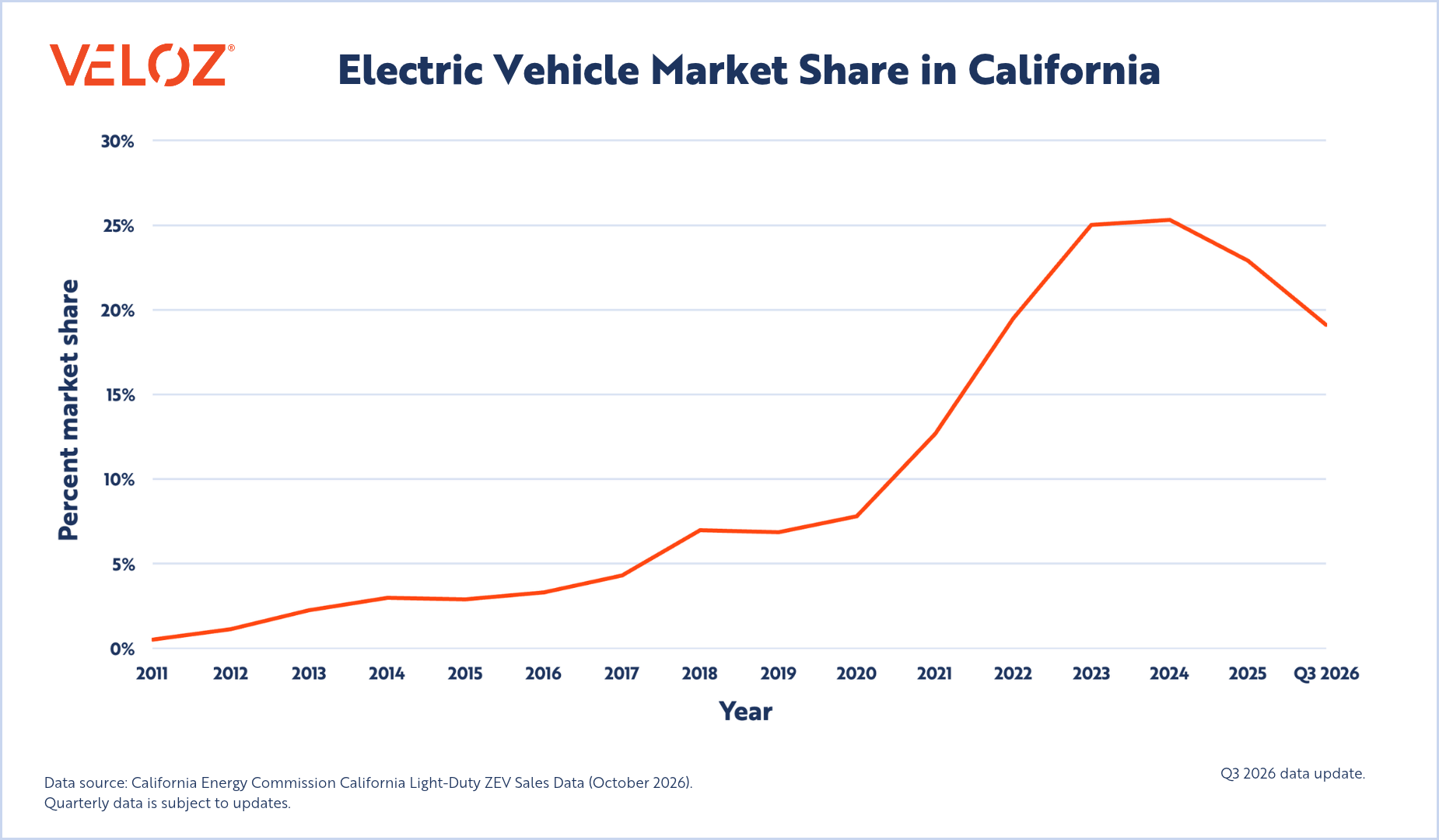
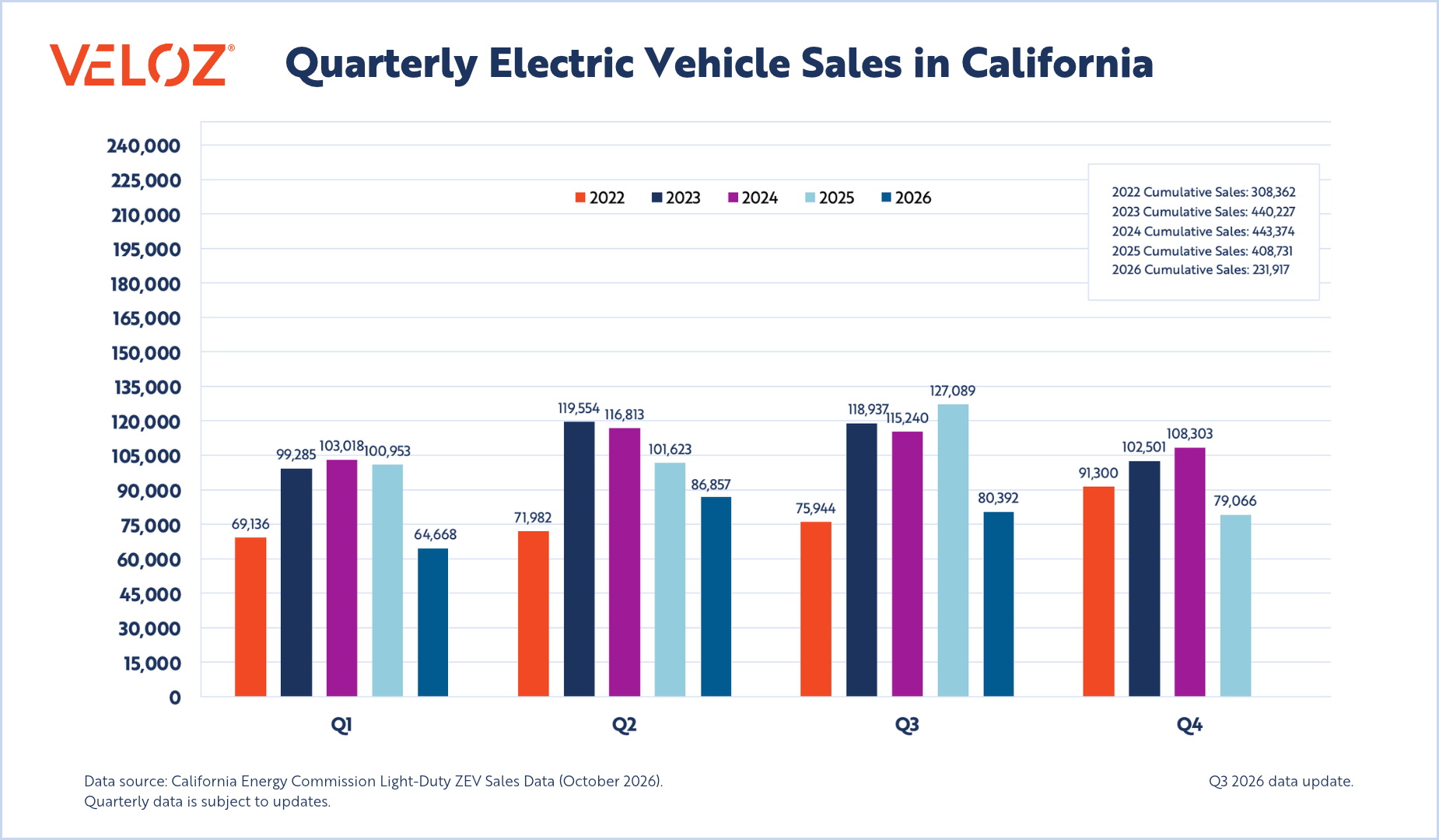
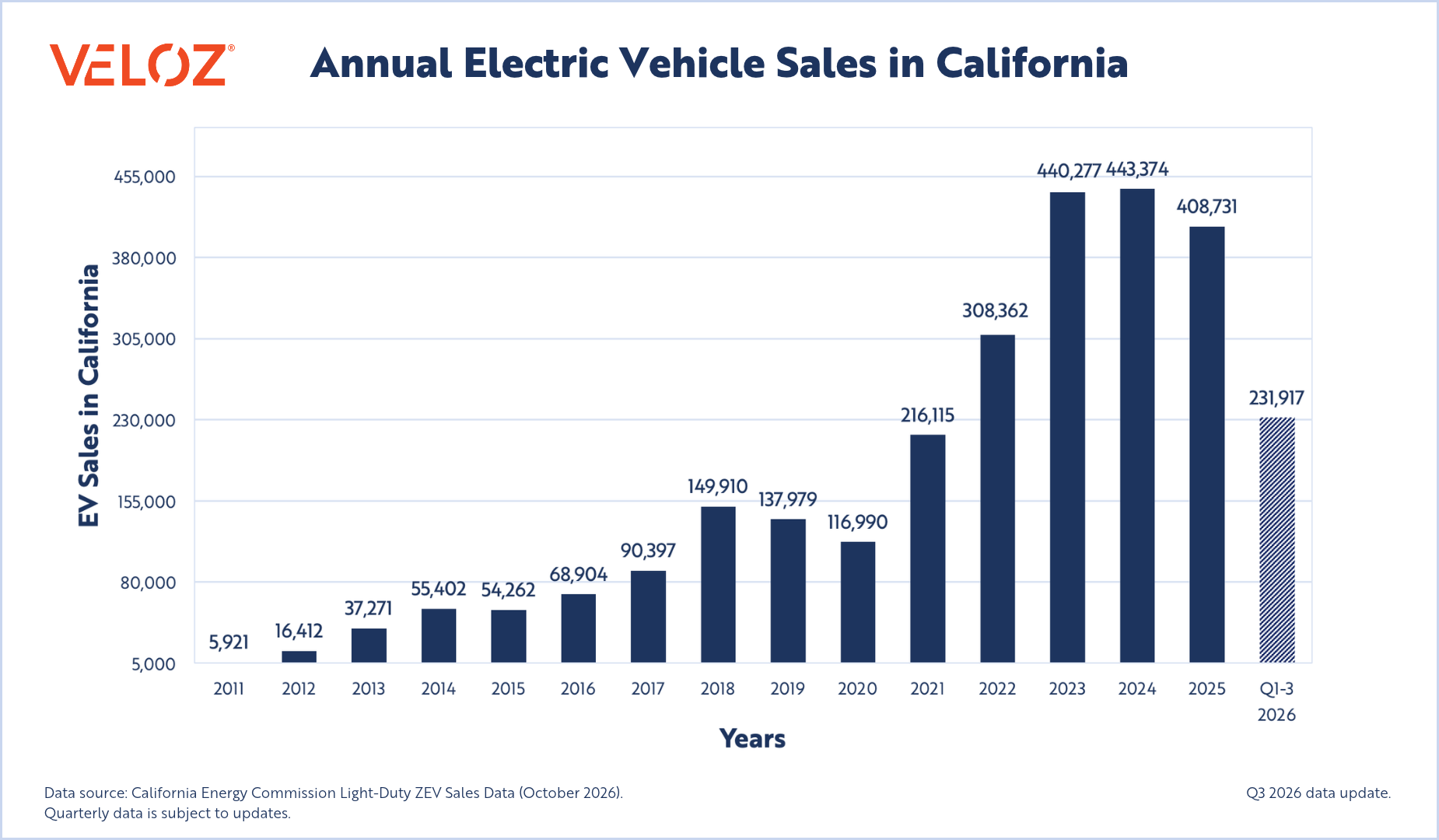
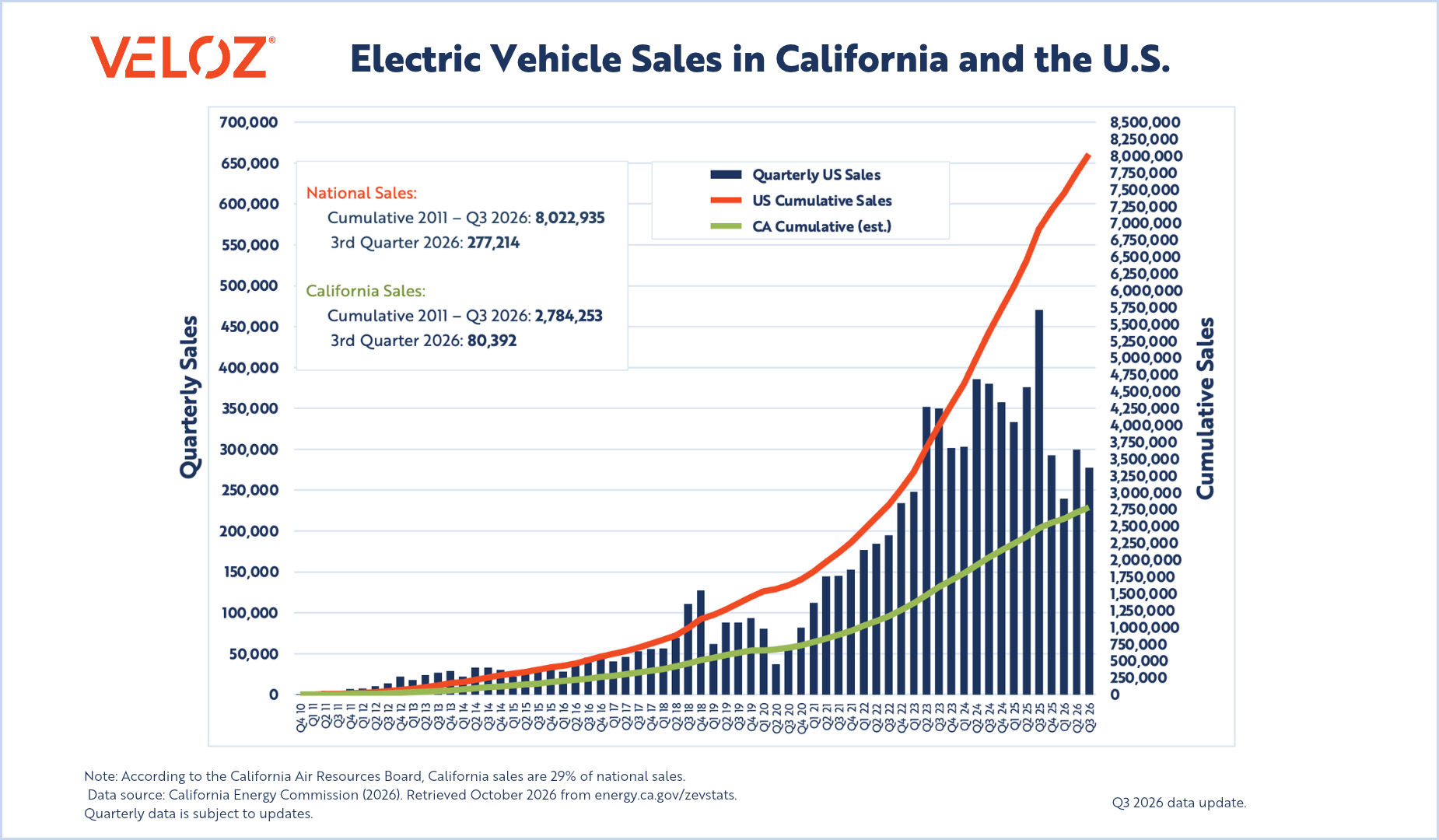
In Q3 2026, Californians purchased 80,392 new electric vehicles (EVs), comprising 19.1% of total new light-duty vehicle sales in the state. The year-over-year new sales market share for Q3 dipped by 9.2 percentage points but held steady relative to last quarter, indicating that California is continuing to stabilize after federal policy headwinds began affecting EV sales nationwide last year. California’s 19.1% new EV sales market share in Q3 reflects an expected decline in demand from the same period last year, when the federal tax credit for used and new EVs was about to expire, boosting Q3 2025 EV sales to 28.3%. At the same time, the current Q3 market share figures represent consistency and stability relative to the 19.1% market share California achieved in Q2 2026.
California Q3 2026: Market Share Trends
Of the 80,392 new EVs sold in Q3, over 85% were battery electric vehicles – indicating a strong driver preference for all-electric models among zero-emission vehicles. Conventional hybrids are also experiencing a surge driven by consumer interest in reducing exposure to high gas prices. This drivetrain class reached 24.1% of Q3 sales, up from 19.5% a year prior. In the used EV market, elevated prices indicate robust demand even as the number of off-lease EVs continues to increase: Cox Automotive’s Manheim Used EV Index increased 4.3% year-over-year in Q3 and used EV sales jumped 21.2% year-over-year nationwide in August to 47,862 units.
Top 10 EVs in California, Q3 2026
Tesla continued to be the state’s EV market leader anchored by Model Y and Model 3 sales while the Toyota RAV4 Plug-in Hybrid became increasingly popular among California consumers as the third best-selling EV model of the quarter.
1. Tesla Model Y
2. Tesla Model 3
3. Toyota RAV4 Plug-in Hybrid
4. Hyundai IONIQ 5
5. Toyota bZ
6. Rivian R2
7. BMW i4
8. Kia EV9
9. Tesla Cybertruck
10. Honda Prologue
Charging Infrastructure Breakdown
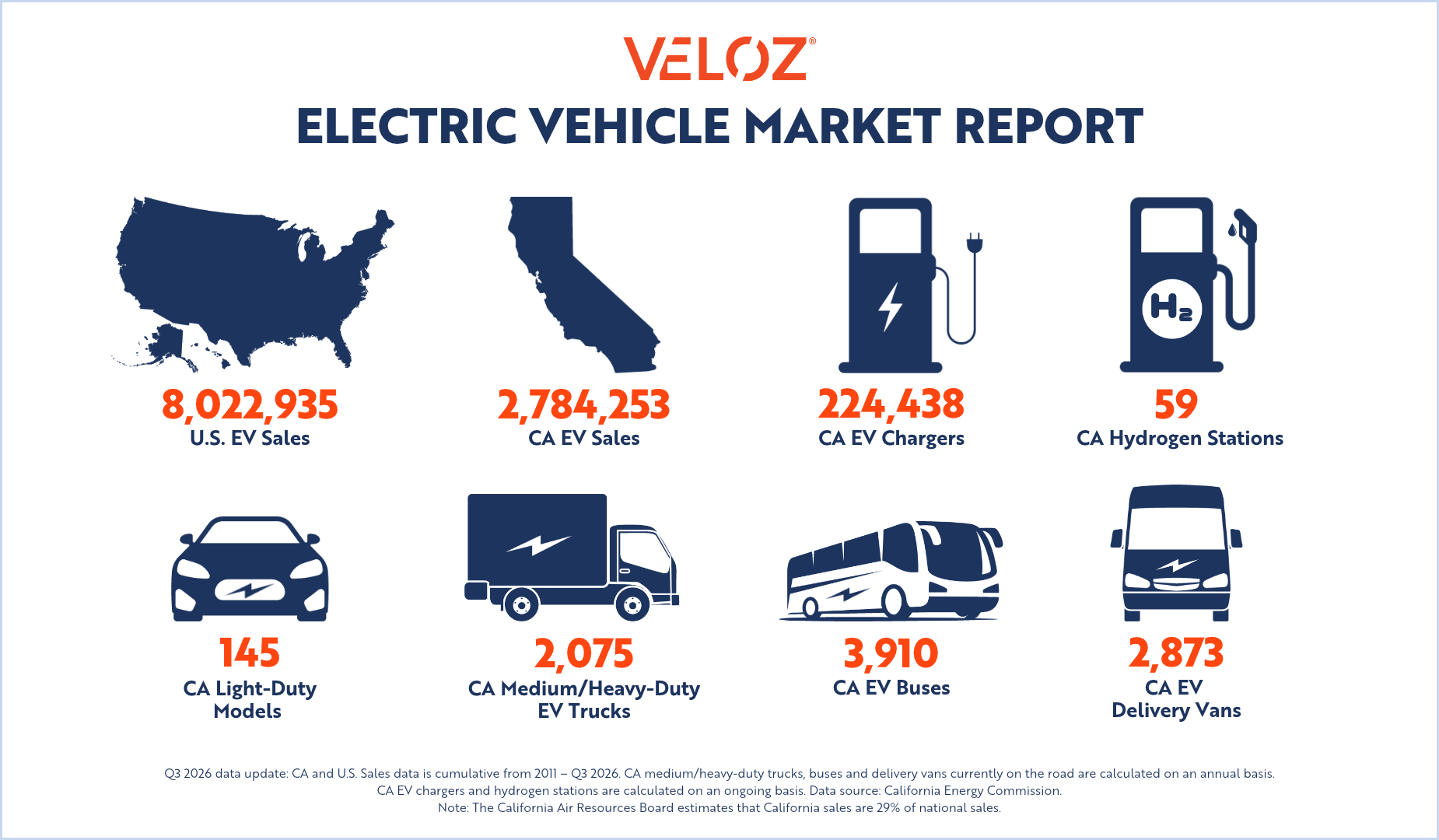
California continues to charge ahead on accessible and reliable access to EV charging. The state now has over 224,000 public and limited access chargers, including nearly 22,000 public fast chargers allowing drivers to refuel quickly and bolster charging confidence. Utilities across the state continue to offer more affordable electricity rates for off-peak charging, magnifying the savings potential from going electric while putting downward pressure on rates for all utility customers. For example, Pacific Gas & Electric and GM Energy announced a new point-of-sale Smart Charge Bundle designed to make home charging simpler and more affordable by enrolling drivers in the utility’s smart charge program in exchange for a Level 2 smart charger at no additional cost. Moreover, convenient charging features like Electrify America’s Plug&Charge and EVgo’s Autocharge+ can make public charging easier than filling up a tank of gas.
California’s Evolving Policy Landscape
In Q3, California policymakers continued to advance EV adoption in the face of federal headwinds. In August, Governor Newsom announced the launch of the California Air Resources Board’s MyFirstEV program to reward first-time EV buyers with up to $3,500 in instant rebates for qualified, affordable EV models. Together with matching incentive contributions from 13 participating automakers, the $271 million initiative has helped nearly 12,000 Californians switch to EVs, demonstrating the effectiveness of point-of-sale incentives compared to post-sale tax credits and incentives. The full impact of the program is expected to be seen in Q4 as automaker participation continued to scale up in Q3.
Furthermore, the California Public Utilities Commission (CPUC) approved new incentives to bring shared, on-demand electric mobility to more Californians through its Rideshare Incentives for Driving Electric (RIDE) program in August. With the program, eligible rideshare drivers can receive new and used EV rebates and incentives to offset the cost of public charging, filling key gaps left by the expiration of federal tax credits. The CPUC also approved Waymo’s service expansion to 18 counties across the state in August, which means riders in the Bay Area, Sacramento, Los Angeles, and San Diego regions can now access autonomous, zero-emission rides.
The California Energy Commission finalized first-in-the-nation replacement tire efficiency standards for light-duty vehicles in August. At a time when Californians have spent $6.75 billion more on gasoline since the start of the global energy crisis in February, these standards promise to save Californians nearly $1 billion on fuel costs annually while slashing emissions.
Finally, California state legislators and Governor Newsom successfully passed a suite of new laws designed to support the state’s EV infrastructure buildout. SB 969 (Reyes) will streamline the process for installing public chargers while maintaining key consumer protections, SB 1283 (Ashby) will reduce permitting delays for complex EV charging projects and accelerate deployment timelines, and AB 1820 (Schiavo) will reduce permitting fee barriers to deploying chargers at multifamily buildings. Governor Newsom also signed SB 615 (Allen), which will improve battery labeling requirements and subsequent EV battery second-life recovery efforts, and SB 913 (Becker), which will allow EVs and other flexible distributed energy resources like battery storage to be aggregated and compensated for their contributions to the reliability of California’s grid. In sum, this successful legislative package should lead to more chargers installed sooner in communities, making it even easier and more affordable Californians to go electric.
California in Context: National and Global Trends
While California’s EV market has proven to be more resilient than the national average, it follows a similar trend to what other states have experienced across the country: a market contraction in Q4 2025 followed by a gradual rebound in new sales. Nationwide, Cox Automotive estimates that EVs comprised 6.4% of total new vehicle sales – a 6.1% quarter-over-quarter increase.
The US recently eclipsed 260,000 public EV chargers, with over 80,000 public fast chargers along freeway corridors and urban areas. Over 4,000 new public fast chargers were deployed in Q3; moreover, fast charging stations are getting larger, faster, and more reliable as more drivers go electric. For example, nearly three-fourths of all new fast chargers installed last quarter had a nameplate charging capacity of 250 kilowatts or higher.
At a global level, EVs reached nearly 30% of total light-duty vehicle sales in August and the International Energy Agency anticipates that light-duty EV sales will hit 28% of total annual sales — or 23 million units — in 2026 overall. Demand for alternatives to gas powertrains continues to soar amidst a sustained global energy crisis that unfolded in February, underscoring the continued volatility of oil markets in the US and abroad. The nearly 90 million EVs on the road across the globe are displacing an estimated 1.4 million barrels of oil a day, reducing drivers’ exposure to elevated fuel prices and saving approximately $4.2 billion a month in avoided gasoline expenditures. Improved model availability and affordability, EV charging expansion, and enhanced EV outreach are also contributing to renewed EV sector growth.
Each quarter, Veloz analyzes California’s EV sales in the context with broader market forces to track how the market is evolving. As the organization behind the nation’s largest and most inventive multi-partner public awareness campaign for EVs, and a convener of leaders across the public and private sectors, Veloz brings both market intelligence and systems-level perspective to its reporting. These quarterly updates reflect current data collected and visualized in collaboration with the California Energy Commission and the California Air Resources Board, offering a clear, trusted view into the momentum shaping the state’s EV market.