Used EV prices reach near-parity with used gas vehicles, charging infrastructure grows, and consumer interest research shows a case for optimism ahead.
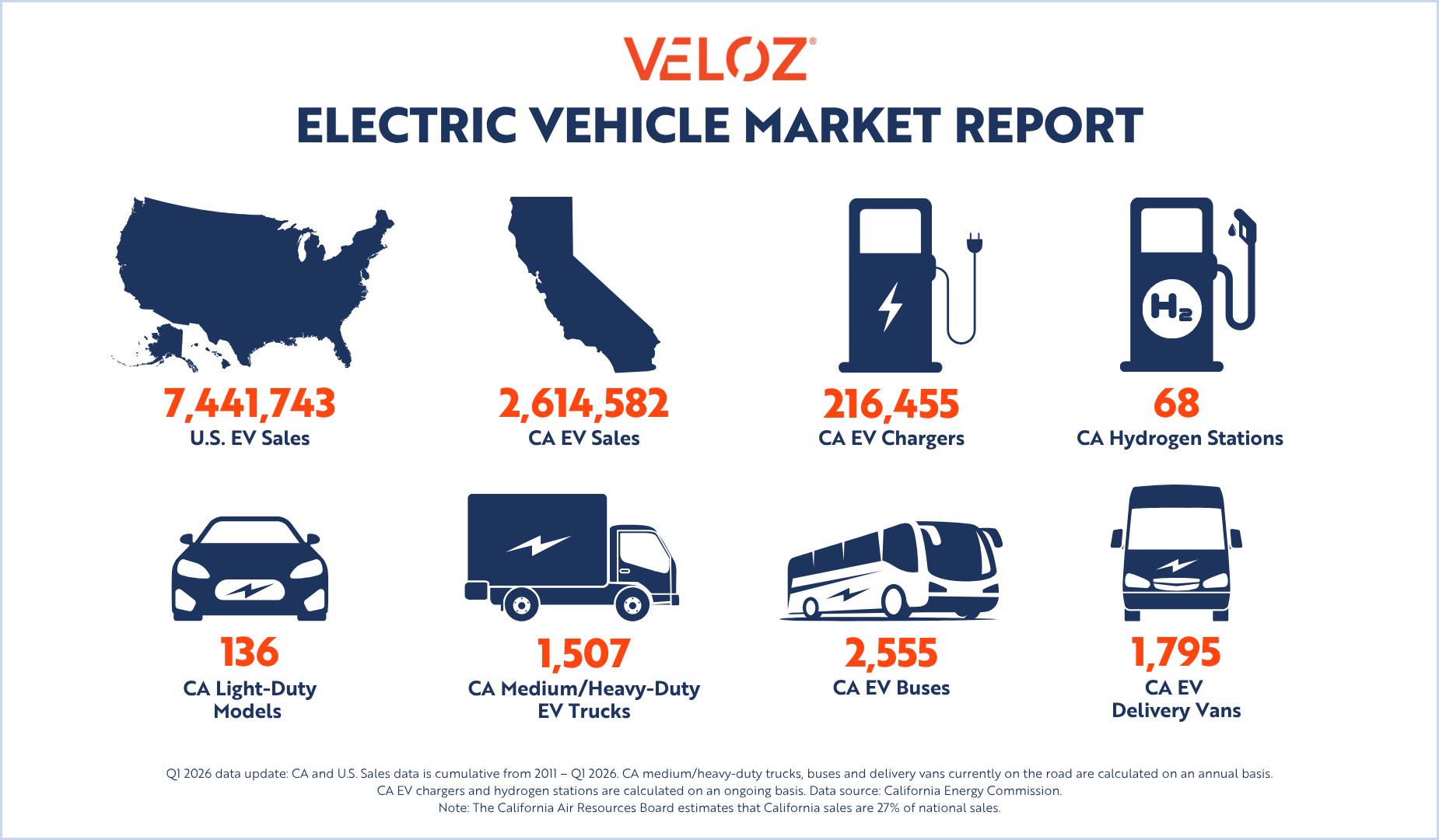
In the first quarter of 2026, Californians purchased 63,461 new EVs, representing 15.7% of all new light-duty vehicle sales in the state. New EV sales were down 37% compared to Q1 2025 and down 20% from last quarter. This reflects a combination of factors, including an increase in new EV sales in the second half of 2025 due to Californians taking advantage of the federal tax credit before it expired, a decrease in overall new vehicle sales in Q1, and the growing uptake of used EVs. Nationally, new EV market share held flat quarter-over-quarter at 5.8% — and used EV sales grew 12% year-over-year, reflecting a market where more affordable options are reaching more buyers at a time when gas prices are soaring. That growth in used EVs tracks with consumer sentiments. Veloz’s message testing research found that EV consideration increased 12 points nationally and 16 points in California after exposure to messaging about savings, across every demographic and political affiliation. With state and local agencies, along with utilities, across the country stepping up to fill the incentive gap left by the expiration of the federal tax credit, the conditions for continued EV growth — affordability, access, and consumer readiness — were all present in Q1 2026. Incentives across the nation are searchable by ZIP code at ElectricForAll.org.
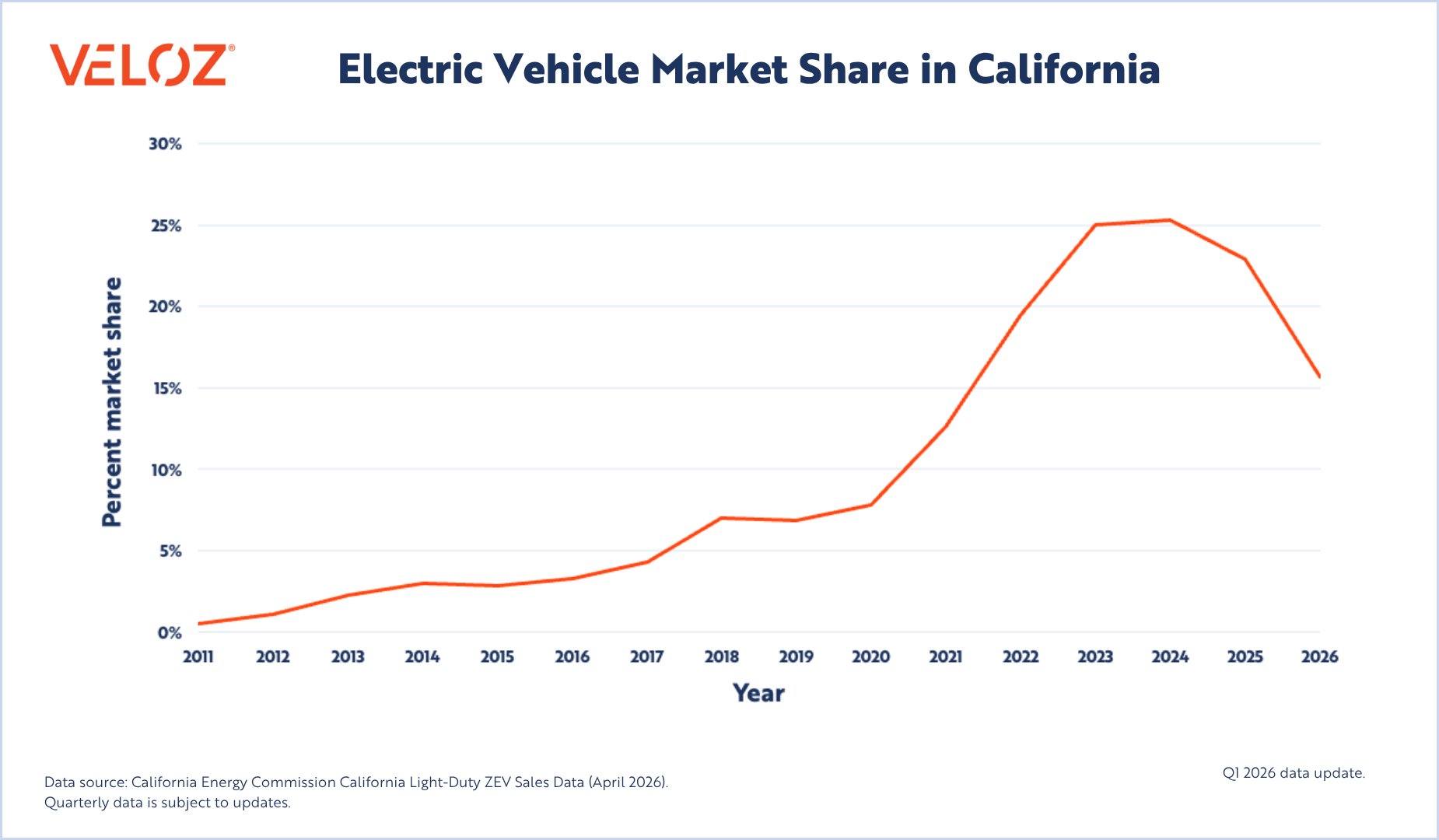
California’s Q1 EV market share of 15.7% compares to 23% in Q1 2025 and 18.9% in Q4 2025. This reflects the expected de-stabilization following the demand of Q3 2025, when record-setting sales were driven by buyers rushing to claim the federal credit before it expired.
Top ten EVs in California, Q1 2026:
- Tesla Model Y
- Tesla Model 3
- Hyundai IONIQ 5
- Toyota bZ
- Tesla Model X
- Rivian R1S
- Chevrolet Equinox EV
- Lexus RZ 350e
- Ford Mustang Mach-E
- Toyota Prius Plug-in Hybrid
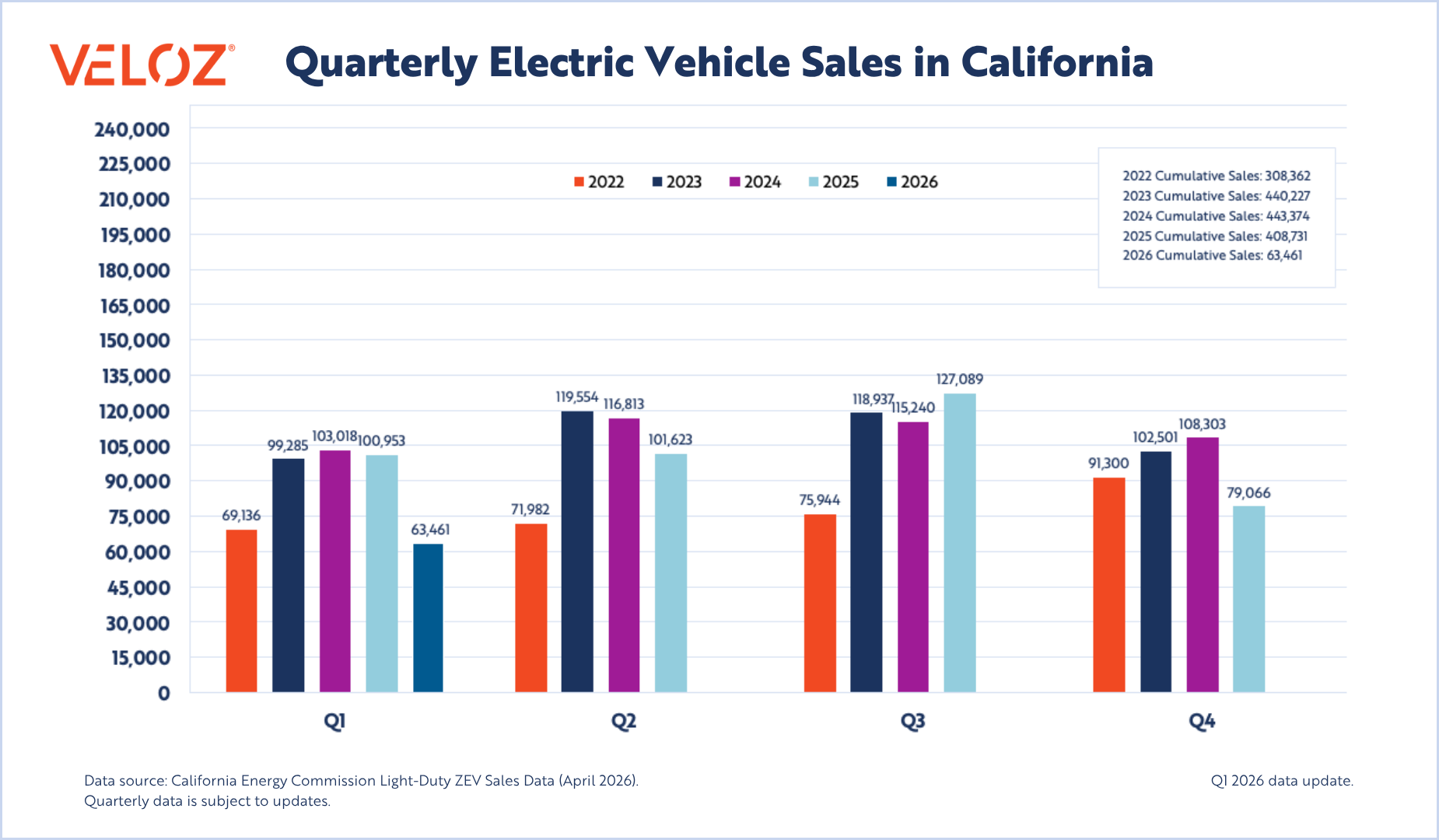
California added 63,461 new EVs in Q1 2026, compared to 100,326 in Q1 2025 and 79,066 in Q4 2025. California’s own policy response is already in motion. Governor Newsom’s proposed $200 million EV incentive program advanced through key milestones this quarter, with the California Air Resources Board moving forward on program design and a public workshop this spring. The proposal could offer point-of-sale rebates for first-time EV buyers on both new and used vehicles, with participating automakers required to match the state’s contribution dollar-for-dollar, effectively doubling the value of the incentive for eligible consumers.
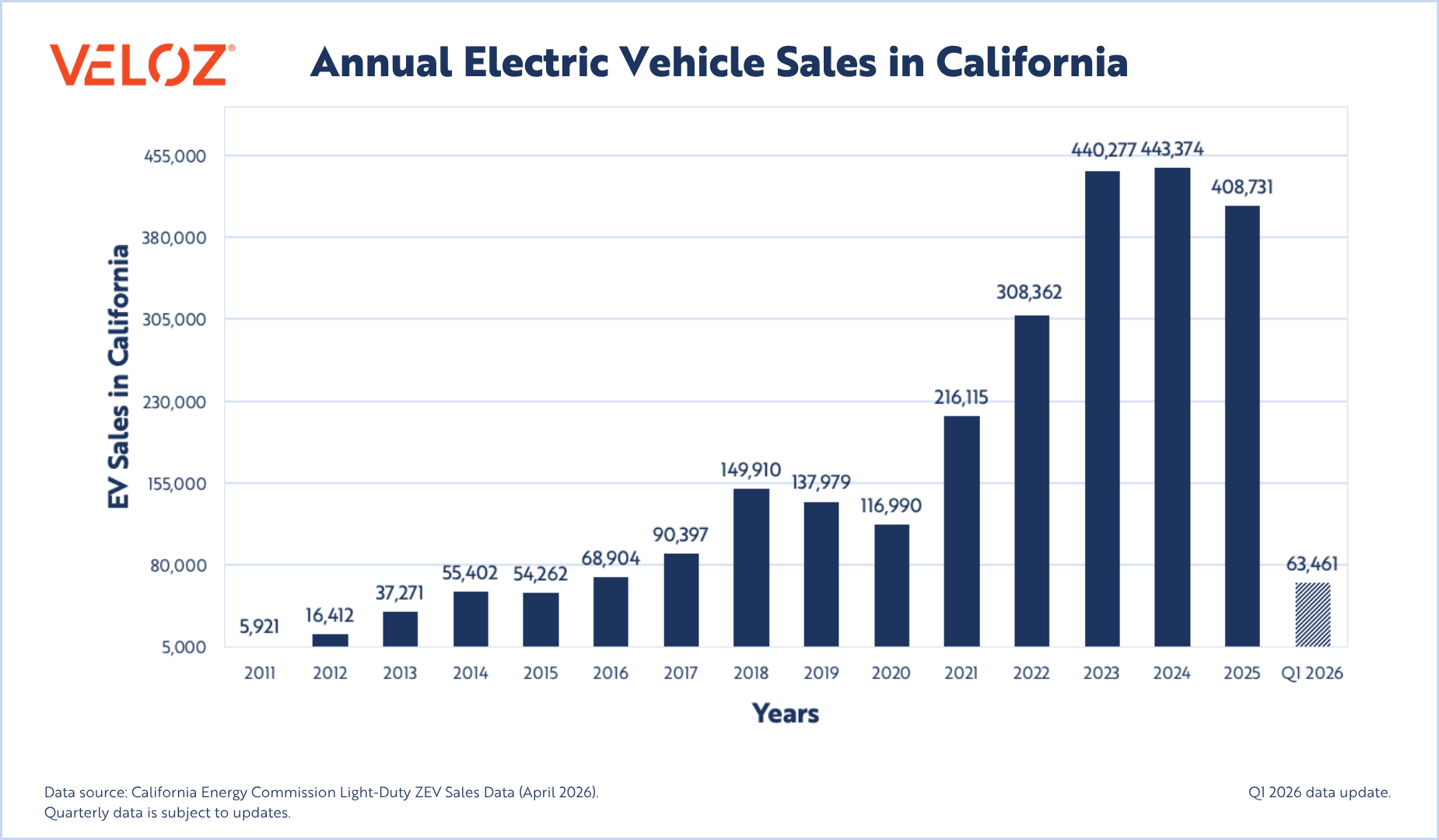
California continues to lead the nation in public charging infrastructure, with over 216,455 public and shared private EV charging ports statewide — more than 20,000 of which are fact chargers — and $98.5 million in light-duty EV infrastructure funding allocated for fiscal year 2025-2026 through the Clean Transportation Program. California’s $79 million in active NEVI-funded grants for highway fast chargers and the $55 million Fast Charge California Project, which closed its application window in January 2026, continue to expand the charging network. The work to close remaining gaps, particularly in disadvantaged communities and multi-unit housing, remains both a policy priority and an increasingly urgent practical need.
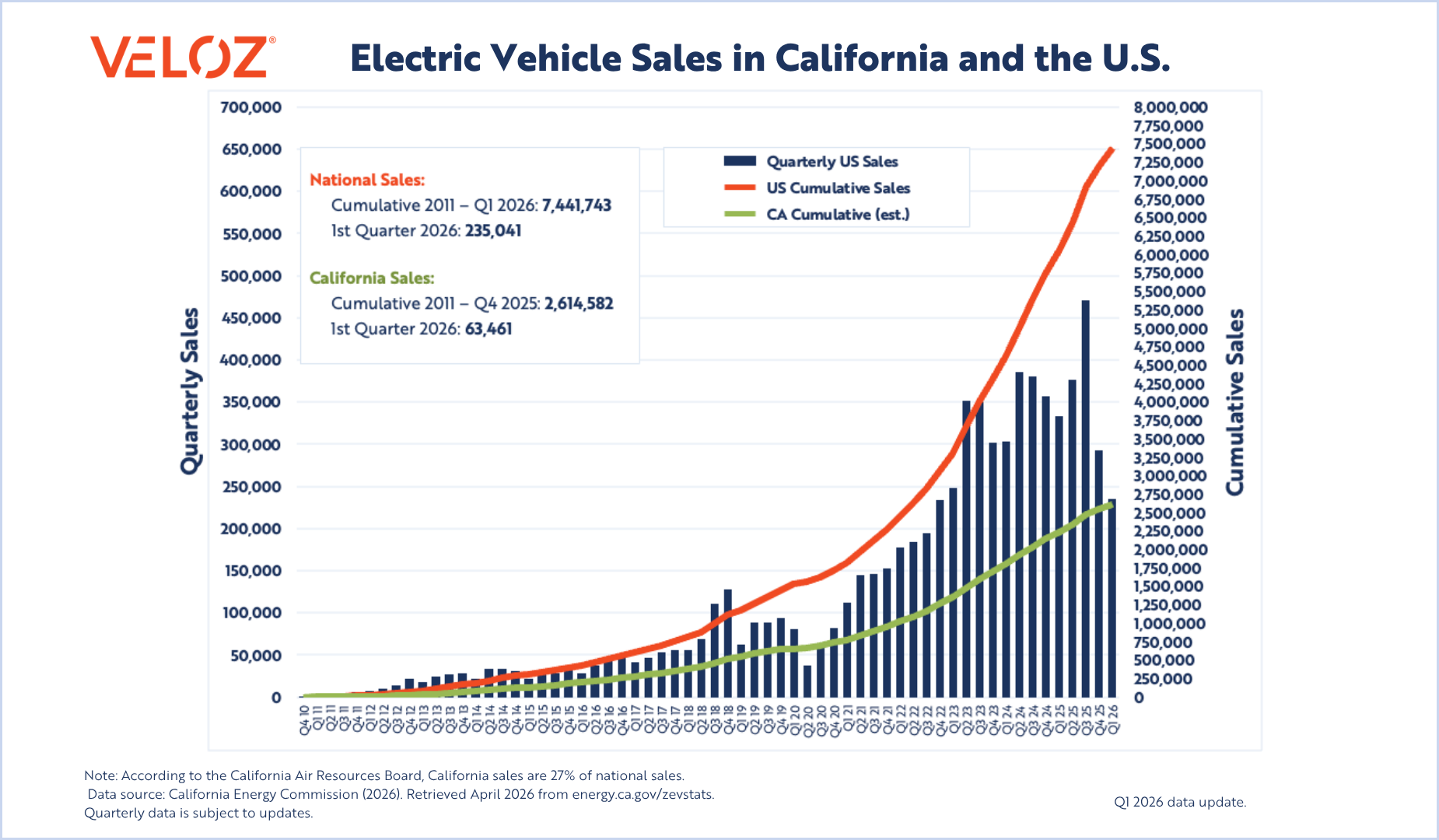
Nationally, new-vehicle sales fell broadly in Q1, and EV market share as a percentage of total new car sales held near steady quarter-over-quarter, a signal that underlying consumer preference for EVs remains intact even as purchase volumes adjust to the new incentive environment. Even as sales volumes adjusted, the national charging network kept expanding: 605 high-speed stations came online in Q1 alone, a 34% increase year-over-year, bringing the national total to nearly 13,500 fast-charging locations — 25% more than a year ago, according to a Bloomberg analysis of federal data.
The most consequential development of Q1 2026 may be found in what is happening in the used EV market. Nationally, used EV sales reached 93,500 units in Q1 2026, up 12% year-over-year and 17% from Q4 2025, according to Cox Automotive. The price gap between used EVs and comparable gas vehicles has narrowed to just $1,300, down from more than $10,000 as recently as early 2023, with used EVs now averaging $34,821. Nearly 44% of used EV transactions in February landed below $25,000, a price point that opens electric driving to a substantially wider range of households. Used EVs are also moving off of dealer lots quickly, averaging just 42 days to sell, nearly on par with gas vehicles, indicating genuine consumer demand rather than inventory accumulation. Cox Automotive projects that the wave of EVs leased between 2023 and 2025, many of them under the IRA’s commercial leasing provisions, will continue flowing back to market throughout 2026 and into 2028, creating a sustained pipeline of well-maintained, relatively new vehicles at accessible price points. Veloz’s Electric For All Used EV Finder gives U.S. consumers a direct path to search available used EVs by ZIP code and budget, alongside the local incentives that can reduce the cost further.
States to Watch
The state-level policy response extends well beyond California’s borders. Across the country, states moved decisively in Q1 2026 to fill the gap left by expired federal incentives, building their own systems to sustain EV momentum.
Efficiency Maine extended its enhanced EV rebates through September 30, 2026, offering up to $8,000 for low-income buyers of new EVs and up to $4,000 for used EVs, with additional tiers for moderate-income buyers, businesses, nonprofits, and government entities.
New Jersey’s Charge Up NJ program updated its terms on March 9, 2026, offering up to $4,000 at point-of-sale for new EV purchases. The state’s EV Tourism Corridor Charging Program closed to new applications on February 23, 2026, after its funding was exhausted — a signal of strong demand. New Jersey has committed $215 million in total EV incentive funding through 2026.
New York’s Department of Environmental Conservation kept its Municipal ZEV Infrastructure Grant ($5 million) and Municipal ZEV Rebate ($585,000) open for applications through February 27, 2026. Six new EVolve NY fast charging hubs are planned for New York City in 2026, adding 70 fast chargers and infrastructure for 280 additional Level 2 ports.
New York’s Drive Clean Rebate Program, administered by the New York State Energy Research and Development Authority (NYSERDA), has made an additional $30 million available for point-of-sale consumer rebates. Rebate amounts range from $500 to $2,000 off the manufacturer-suggested retail price (MSRP) of a battery-powered EV or plug-in hybrid, with a higher rebate available for longer-range EVs.
Illinois extended its IEPA EV Rebate Program application window to May 31, 2026, with $14 million appropriated and up to $4,000 available for low-income buyers. A new state law that took effect January 1, 2026, requires 40% of parking spaces in condominium and common interest communities to be EV-capable, laying the groundwork for broader residential charging access.
Maryland’s FY26 EVSE Rebate Program has $2.5 million in active funding for residential and commercial charger installations, running on a first-come, first-served basis through the fiscal year, alongside a $3,000 EV excise tax credit for qualifying vehicle purchases.
Each quarter, Veloz analyzes California’s EV sales to track how the market is evolving in real time. As the organization behind the nation’s largest and most inventive multi-partner public awareness campaign for EVs, and a convener of leaders across the public and private sectors, Veloz brings both market intelligence and systems-level perspective to its reporting. These quarterly updates reflect the most current data collected and visualized in collaboration with the California Energy Commission and the California Air Resources Board, offering a clear, trusted view into the momentum shaping the state’s EV market.
For media inquiries, please contact Margaret Mohr, Veloz Communications Director, at [email protected].